



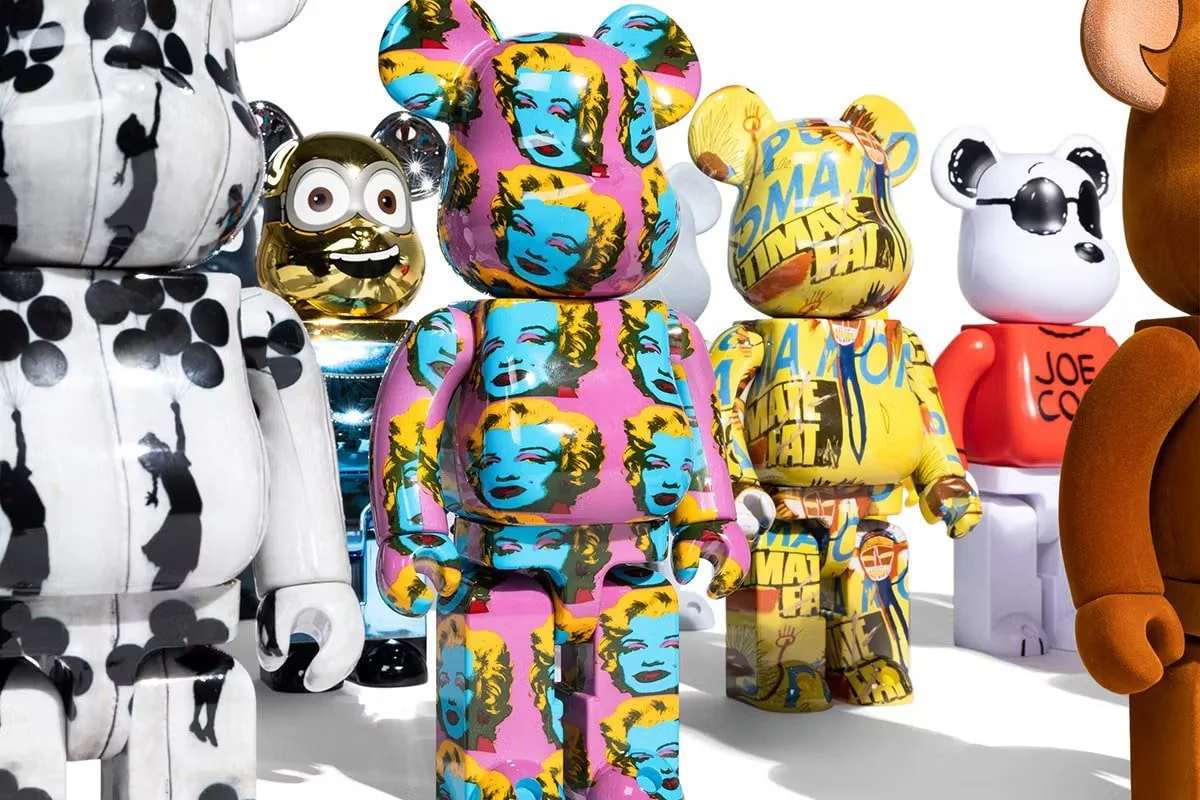
Are Bearbricks a good investment? A handful of rare releases have produced impressive returns, but many Bearbricks remain near retail or lose value once the initial hype fades. A famous collaborator, large size or limited-edition label can help, but none of those features guarantees a profitable resale.
The useful question is not whether Bearbricks as a category increase in value. It is whether the exact figure you want has lasting buyer demand at a price that still leaves room for resale costs.
1. Record prices do not represent the whole Bearbrick market
The Bearbricks that make headlines are usually one-of-one artworks or early collaborations with names such as KAWS and Chanel. Those sales are real, but they sit at the top edge of a market containing thousands of less valuable releases.
In its 2022 buyer’s guide, StockX reported that most Bearbrick models on its platform sold for approximately $100 to $1,000. The same guide noted that dozens of figures had traded below retail, including the Andy Warhol “Brillo” 1000%. StockX
That is why a high marketplace listing should never be treated as proof of value.
- Retail price is what the figure originally cost.
- Asking price is what a seller hopes to receive.
- Sold price is what a buyer actually paid.
A seller can list a Bearbrick for $20,000 and leave it online for months. Until a transaction takes place, that number says more about the seller’s expectations than the market.
Completed sales are more useful, but they still need context. Condition, packaging, location and the number of active buyers can cause two examples of the same design to sell for very different prices.
2. What drives Bearbrick investment value?
2.1 Demand for the collaborator
A Bearbrick connected to an established artist or brand can attract more than one collector group. A KAWS release, for example, may appeal to Bearbrick fans, KAWS collectors and contemporary art buyers.
That crossover can support demand long after the original drop. However, the collaborator’s name alone is not enough. Different colorways and releases from the same artist often trade at very different prices.
Instead of asking whether the artist is famous, check whether buyers are still completing purchases for that exact model.
2.2 Genuine scarcity
A sold-out Bearbrick is not necessarily rare. Resellers may still hold large quantities, or buyer interest may disappear after launch.
Medicom Toy does not normally publish the production number for every release. You may need to judge scarcity through marketplace activity:
- How often does the figure appear for sale?
- How many completed sales can you find?
- Are new listings being purchased or sitting unsold?
- Was distribution restricted to an event, lottery, region or retailer?
- Is the stated edition size supported by a reliable source?
Scarcity creates value only when the number of interested buyers exceeds the number of owners willing to sell.
Series releases introduce another type of scarcity through randomized pulls. Our guide to how blind-box rarity works explains the difference between common, rare and secret editions without assuming every difficult pull will become valuable.
2.3 Purchase price
A desirable Bearbrick can still be a poor purchase if you pay too much.
Suppose a release retails for $500 and jumps to $1,200 during launch week. Even if it remains popular, the person entering at $1,200 has much less room for error than someone who secured it at retail.
Buying at or near retail does not guarantee a profit, but it provides a wider margin of safety. A good collectible and a good deal are not always the same thing.
2.4 Condition and packaging
Bearbricks have large, exposed surfaces that can make damage easy to spot. Before purchasing a used figure, inspect:
- Scratches on the face, chest and back
- Paint wear around hands, feet and joints
- Yellowing on white or clear plastic
- Sun fading and color changes
- Loose or damaged joints
- Strong smoke or storage odors
- The original box, inserts and accessories
- Receipts or certificates supplied with the release
Opening a large display Bearbrick does not automatically destroy its value. Physical condition and complete packaging are usually more useful indicators than whether the box has ever been opened.
The effect of a missing box varies by release, so avoid applying a fixed percentage discount without comparable sales.
2.5 Authenticity and provenance
A figure with a traceable purchase history is easier to sell than one with an uncertain origin. This becomes particularly important as prices rise.
For higher-value purchases, keep the original receipt, retailer confirmation, auction invoice and any certificate included with the release. Packaging and product markings can support an authentication check, but neither should be treated as foolproof because counterfeiters can copy boxes and stamps.
Be cautious when a seller:
- Refuses to provide detailed photographs
- Cannot explain where the figure came from
- Uses only stock images
- Pressures you to pay outside a protected marketplace
- Offers a price far below recent sales without a clear reason
A steep discount is not useful if future buyers will question whether the figure is genuine.
If you are still comparing retailers and resale platforms, our guide to where to buy authentic Bearbricks covers official sources, established U.S. retailers and the differences between StockX and eBay.
2.6 Size and liquidity
A larger Bearbrick usually has a higher absolute price, but size alone does not create a better return.
StockX described the 400% Bearbrick as its most-traded size in its 2022 guide. Official Medicom Toy specifications place a standard 400% figure at approximately 280 mm tall. Medicom Toy
A 1000% Bearbrick stands approximately 700 mm tall. Its weight depends on the design and material, but Medicom lists the Black Heart 1000% at about 7 kg. Medicom Toy
The larger format creates practical limits. Fewer collectors have room for one, international shipping can be expensive, and storing the original box requires almost as much planning as displaying the figure itself.
3. What auction results reveal about Bearbrick value over time
Heritage Auctions has recorded several sales of the Coco Chanel 1000%, a highly recognizable design released in 2006.
| Bearbrick | Auction date | Recorded sold price |
|---|---|---|
| Coco Chanel 1000% | July 2019 | $23,750 |
| Coco Chanel 1000% | November 2022 | $17,500 |
| Coco Chanel 1000% | November 2023 | $14,375 |
The auction house also recorded two sales of the 2013 KAWS Chompers 1000%.
| Bearbrick | Auction date | Recorded sold price |
|---|---|---|
| KAWS Chompers 1000% | February 2024 | $8,125 |
| KAWS Chompers 1000% | July 2024 | $7,500 |
These results come from the Heritage Auctions BE@RBRICK archive.
They should not be read as a perfect price index. Each auction lot may have differed in condition, packaging, provenance and buyer interest. What the results demonstrate is that even established Bearbricks do not automatically become more valuable with every passing year.
The wider market has also experienced cooling periods. In a 2023 ABC News report, a Melbourne collectibles retailer said Bearbrick prices had dropped amid economic pressure and oversaturation. Collector Silas Chau estimated that a READYMADE x BAPE 1000% he bought for $18,000 was then worth around $10,000. ABC News
That estimate is not a current appraisal of the figure. It is evidence that even a recognizable collaboration can fall sharply when demand changes.
4. How to value a Bearbrick before buying
Begin by identifying the exact release. Similar names, colorways and sizes can have very different resale histories.
Step 1: Confirm the model
Record the full product name, size, colorway, release year, collaborator and material. For a set, check whether all included figures and accessories are present.
Step 2: Search for completed sales
Use sold or completed filters rather than relying on active listings. Check more than one marketplace where possible because regional demand can produce different prices.
Auction archives are particularly useful for rare art collaborations. Mainstream marketplaces may provide more relevant comparisons for widely traded 100%, 400% and 1000% releases.
Step 3: Match the condition
Do not compare a mint, boxed figure with a scratched example missing its packaging. Look for sales that match the condition of the figure you are considering.
Step 4: Remove obvious outliers
One unusually high transaction may reflect a bidding contest, unusual provenance or a buyer who overpaid. One unusually low sale may involve damage or an incomplete listing.
A cluster of comparable transactions is more useful than the highest result you can find.
Step 5: Check how often it sells
A Bearbrick may appear valuable because the only visible listing is expensive. If the most recent completed sale happened several years ago, the figure may be difficult to convert back into cash.
Repeated transactions at slightly lower prices can be more useful than one impressive sale followed by silence.
Step 6: Calculate your total entry cost
Include:
- Purchase price
- Sales tax
- Shipping
- Import duties
- Authentication charges
- Currency conversion costs
These costs become part of the price the Bearbrick must exceed before you make a profit.
Step 7: Set a maximum price
Decide what you are willing to pay before entering an auction or negotiating with a seller. This prevents a visually impressive figure or last-minute bidding competition from overriding the sales evidence.
5. Is a 400% or 1000% Bearbrick better for resale?
| Factor | 400% Bearbrick | 1000% Bearbrick |
|---|---|---|
| Entry price | Usually lower | Usually higher |
| Display space | Easier to accommodate | Requires substantial space |
| Shipping | Simpler and less expensive | Bulky and potentially costly |
| Buyer pool | Often broader | More limited |
| Absolute resale price | Usually lower | Can be much higher |
| Practical advantage | Easier to collect and move | Strong centerpiece appeal |
A 1000% Bearbrick has a higher price ceiling, but it also has a smaller pool of practical buyers. A collector who loves the design may still pass because of space or shipping.
For someone buying a first Bearbrick with resale in mind, a 400% release with regular completed sales may be easier to understand and eventually sell. That does not make 400% universally more profitable. The exact model and entry price remain more important than size.
6. Calculate the return you would actually keep
Suppose a Bearbrick costs $450, plus $30 in tax and shipping. Your total entry cost is $480.
You later sell it for $700. Marketplace fees, payment costs and outbound shipping total $110.
- Sale price: $700
- Selling costs: $110
- Total entry cost: $480
- Net profit: $110
- Net return: approximately 22.9%
Looking only at the $450 sticker price and $700 sale price would make the gain appear much larger than it is.
Use these formulas:
Net profit = sale price − selling costs − total entry cost
Net return = net profit ÷ total entry cost × 100
Platform fees and shipping rates change, so calculate them using the marketplace and destination you expect to use. Until the figure sells, any apparent gain remains an estimate.
7. Risks that can turn a desirable Bearbrick into a poor purchase
Hype may fade before you can sell
Launch-week demand can disappear once collectors move to the next collaboration. A fast initial price increase may be the least attractive time to buy.
Rare does not mean liquid
A figure can be difficult to find and still have very few buyers. This is particularly relevant to expensive pieces tied to niche artists or regional brands.
Storage damage can build slowly
Direct sunlight, humidity, smoke and careless handling may alter the finish before the damage becomes obvious. Chrome, clear plastic and light colors can be particularly unforgiving.
Shipping can absorb the margin
A profitable-looking 1000% sale may become much less attractive after packing materials, insurance and long-distance delivery are included.
Regional demand can distort the price
A Bearbrick popular in Hong Kong or Japan may attract fewer buyers in the United States or Europe. Import costs can also make the same figure appear more valuable in one market than another.
New alternatives can divide attention
A new colorway, related collaboration or more affordable release can give collectors another way to own a similar design. The original may remain rare while becoming less urgent to buy.
8. So, are Bearbricks a good investment?
If your decision depends on the figure rising in price, do not buy it without strong completed-sale evidence and a realistic exit route.
A better rule is simple: buy a Bearbrick you would still be happy to own if its resale price never increases. That protects the part of the purchase you can control. If demand grows later, the financial return is an additional benefit rather than the only reason the figure deserves space in your collection.
9. FAQs
Are Bearbrick editions individually numbered?
Most standard Bearbrick releases are limited but not individually numbered, and Medicom Toy does not typically disclose exact production totals. Certain art editions and special projects may be numbered, so check the documentation for the specific release.
Where can you sell a Bearbrick?
Common releases may be sold through collectible marketplaces or general platforms with completed-sale histories. Rare art collaborations may be better suited to specialist dealers or auction houses that can assess provenance and reach experienced buyers.
Do custom Bearbricks have resale value?
A custom Bearbrick can have value when the artist has an established following and the work has clear provenance. It should not be priced as if it were an official Medicom collaboration unless it was produced or licensed as one.
What is the most expensive Bearbrick ever sold?
The one-of-one Yue Minjun “Qiu Tu” Bearbrick reportedly sold for approximately $157,000 after its 2008 debut. Its status as a unique artist piece makes it a poor benchmark for regular retail Bearbricks. The Straits Times